
A 26-Year Journey: Solo Timpanist Torino Tudorache with BIPO
Torino Tudorache, a solo timpanist in the Borusan Istanbul Philharmonic Orchestra (BIPO) since its founding, shares insights into his 26-year journey, and his reflections on the unifying power of music.
A member of the Borusan Istanbul Philharmonic Orchestra (BIPO) since its founding,
timpanist Torino Tudorache reflects on this 26-year journey from his own perspective. Highlighting the dedication behing the orchestra’s international success, the unifying force of music, and the subtle artistry behind rhythm on stage, Tudorache emphasizes that BIPO is not only a symphonic ensemble, but alsı a shared identity and a collective spirit.
You have been a member of the Borusan Istanbul Philharmonic Orchestra (BIPO) since its foundation. What has this journey meant to you, from its very beginning to the present day?
Looking back now, I realize that the 26 years I spent with the BIPO have passed very quickly. Reflecting on this time, I see that it was an immense amount of work built upon a perfect environment of seriousness, meticulousness, and top-level professionalism from every musician involved.
I cannot fail to mention that at the foundation of the creation of this wonderful orchestra stood—and continues to stand—the generous and remarkable Kocabıyık family, who believed in this project from the very beginning. They entrusted the formation of the BIPO to the conductor and professor Gürer Aykal. These are fundamental things that must never be forgotten.
To answer the question directly: I have given this orchestra all of my professionalism. Therefore, BIPOrepresents a part of my soul, and I am certain that I am also a part of the soul of this orchestra.
In your view, what are the advantages of being part of a long-standing orchestra in terms of musical communication? How would you describe the shared musical language within BIPO?
Both I, as a timpanist, and every musician in the orchestra have dedicated all our professionalism and knowledge so that the orchestra’s level would reach the very top. After intense work, the results did not take long to appear.
Today, BIPO is a brand—a top orchestra known throughout the world—and it has developed its own special musical language. Often, when I speak with various conductors and tell them that I am the timpanist of this orchestra (BIPO), their immediate reaction is: “Wow, fantastic orchestra!”
You see? That means a lot.
How did you first encounter the timpani? At what point did you decide to place this instrument at the centre of your career?
It is a beautiful story. My father was the principal trombonist at the Philharmonic Orchestra in Oradea, in western Romania. The timpanist of that orchestra was a remarkable musician and a close friend of my father. When I was a child, the very first time he saw me, he said: “I will make you a great percussionist!”
My father trusted him. I remember that from the very first moment I was fascinated by percussion instruments. Soon after, I studied at the Music High School in Cluj and later at the Music Academy in the same city.
When I was young, I suffered greatly from being separated from my parents, and I believe this pushed me to study very intensely. I had the chance to study with outstanding professors whom I will carry in my heart forever.
The timpani fascinated me from the very beginning—their imposing presence on stage, their sound, their intensity, the rhythm you propose to the orchestra, and above all the constant communication with the conductor, which must be almost perfect. The audience sees this, feels it, and understands it.
The programme for the 12 March concert presents a multi-layered repertoire, ranging from the roots of folk music to the dramatic world of opera. As a timpanist, how do you experience this intercultural musical journey?
Some of the works from both the previous concert and the present one are included on the latest CD recorded by BIPO last summer under the direction of Carlo Tenan. The album includes works by monumental composers such as Bartók, Kodály, Martinů, Enescu, and Richard Strauss.
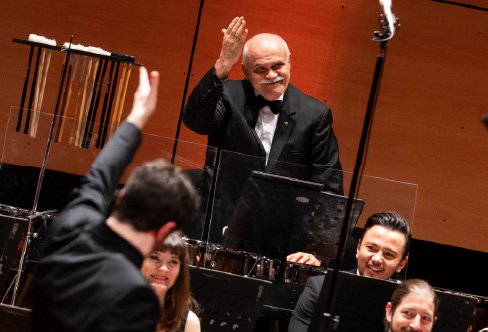
These composers were largely shaped by Eastern Europe, where music and folk motifs play a decisive role. Over the years, I have noticed that the rhythmic structures found in their compositions often become the highlight of the works. The mathematics of the music is perfect.
Personally, I understand these details very well because my origins are from that part of Europe. As a timpanist, I discover that each work requires a completely different approach.
Bohuslav Martinů’s The Frescoes of Piero della Francesca is rarely performed in Türkiye. Inspired by Renaissance painting, the work evokes a highly visual world through music. As a percussionist, how do you contribute to this “symphonic tableau”?
With Bartók and Kodály, you must be mathematically precise. If not, the orchestra can lose its rhythmic balance.
With Enescu, you must be rigorous and meticulous—almost every note contains detailed indications. Then suddenly Enescu becomes implosive and explosive.
With Martinů, I approach colours and nuances. It is a more delicate music that requires a certain rhythmic discipline.
Richard Strauss stands out through colour, velvet-like sonorities, explosions of sound, and strong rhythm. We must not forget that Strauss is one of the most extraordinary orchestrators in history.
At the end, I would like to add a few words. BIPO is one of the most representative orchestras in Türkiye. During these 26 years of its existence, the orchestra has formed its own audience. In this entire equation, the audience plays a decisive role. The audience can never be deceived.
The reaction of our audience after each concert is electrifying, and this tells us that we are on the right path. We are in harmony with our audience.
Today we all witness wars and conflicts with a sense of helplessness. We all ask ourselves: How did we get here? Why? How is it possible?
I firmly believe that now, more than ever, we all need something that has the power to unite us and to bring us together as a common front. That “something” is, without a doubt, music.
Music has always meant peace.
I bow—and we bow—to our beloved audience.
Share on


