
With Barbara Hannigan on Her New Project “La Voix Humaine”
One of the most impressive performers of our time, conductor and soprano Barbara Hannigan shares with us her interdisciplinary production experience and her project “La Voix Humaine”.
In addition to her career as a conductor and soprano, Barbara Hannigan is one of the most inspiring figures in today’s music world with her avant garde projects and impressive stage performance. On December 11, she shared the stage with the Borusan Istanbul Philharmonic Orchestra for her project “La Voix Humaine”, performed for the first time for an audience in Türkiye. Not letting this opportunity slip by, we had a most enjoyable interview with her. We are delighted to bring you this interview, in which we talk about many things from her identity on stage to her interdisciplinary approach to production and how she prepares for a concert.
Is there a line or a musical moment in La Voix Humaine that holds a special meaning for you?
I would say every performance and even every rehearsal has lines that stand out. And what's so wonderful is that they are always different. it depends so much on the way the piece starts out - the "edge" I might have in the subtext, or the gentleness which might unexpectedly emerge. I often play the most painful lines with a hint of humour, as if "Elle" is in such a state that she can take everything with a smile, no matter how painful. I love to find the humour in the darkest moments. So, to answer your question, I'll name a few lines which I particularly love:
"Parce que les choses que je n'imagine pas...n'existe pas. Ou bien, elles existent dans une espece de lieu tres vague..." In this line, towards the end of the opera, Elle confesses that she needs her imagination to "save" her from the painfulness of confronting reality
"Oui, je t'écoute, je serai sage, je repondrai a tous je te jûre...." Here she assures her ex-lover that she will be a good girl and answer all his questions. At this moment I conduct very "square" kind of like a student conductor who is trying to impress the teacher but not connected to the music.
How do the rhythm and energy of your body on stage synchronise with the music? Is this something you can consciously control as a technique?
Everything is in synchronicity with this piece. It is a total incorporation of the music, the text,the breath before singing, the thought before speaking, the subtext, the singing, acting, and the conducting. I am consciously controlling everything but this is only possible after an enormous amount of preparation and study. It is a kind of freedom/flying/flow which uses top level machinery of voice, brain and psyche.
When creating a performance that blends multiple elements, how do you design your rehearsal flow?
When I was preparing the piece, I went into a studio just with a pianist, and went over and over the piece, singing and letting myself find gestures through a kind of improvisation. Little by little I found gestures that were both expressive to the story and effective to the musicians. After a few weeks, I then began working with the three cameras and at that time, a large tv screen. Clemens Malinowski was operating the cameras and it was a bit like we were do a dance improvisation until we found this move and that move, switching to different cameras. Sometimes the "mistakes" became our favorite parts of the show, a camera shot that froze, for example, became something we use at the first lyrical moment of the piece, when I finally turn to face the audience for the first time. This moment was discovered purely by chance. We then translated this material to the large screen. Every rehearsal is different, every performance is different and we are always in a kind of development state, never becoming fixed or complacent with what we have done before, even if it was successful.
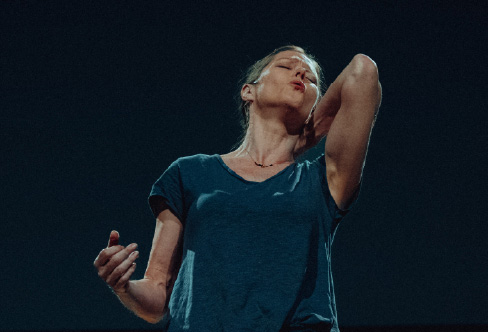
Once we are with orchestra, our time is very limited. So we have technical rehearsals outside the orchestra rehearsals, and its very compact and intense in the final two days. The orchestras are always very excited by the project - naturally they have never experienced anything like it and everyone comes to a high level of very fine-tuned accuracy and awareness.
How does working across so many disciplines shape your daily routine? Are there things you consider essential — rituals or practices you always keep in place?
I think its quite natural for me: singing, studying my scores, organizing things around the engagements, being on the phone mentoring young professionals, searching for new music, going for my daily run, cooking. I make a kind of schedule for the day and for my practise sessions as a guideline but it does not remain fixed and very rarely do I achieve all the tasks I have set for myself each day. but surely without the schedule I wouldn't even achieve half of it!
What would you say is the greatest difference, from your own perspective, between “Barbara Hannigan” on stage and in everyday life?
Oh, I think I'm pretty well the same. I've felt this for a long time. Not a big difference. More makeup maybe...
What genre of music do you listen to the most, apart from classical music?
I like all kinds of music. I've been listening to all of Björk's albums. People recommend things to me. FKA Twigs, for example, was recommended by a friend recently. And Clarissa Connelly who I didn't know about. And of course I listen to Barbra Streisand.
Share on


